Key strategies and insights for developing a business case
|
Post written by

Discover different types of communities, build a strong business case, and integrate it into your brand strategy and business model. From boosting website traffic to strengthening brand loyalty—discover the benefits of these communities. Whether you want to drive sales or gather insights, you can leverage the various revenue streams they bring to reach your goals. Connect with your audience, spark engagement, and drive your brand forward. § Challenges when starting an online community § To build a successful online community that fits your company, you need to choose the right type, align it with your brand, and create a solid business case. This article outlines different community types, the importance of integration, and monetization. It addresses the challenge of connecting the community to your business, with a focus on brand loyalty, web traffic, and data collection. § Background § As businesses continue to navigate the digital landscape, the concept of online communities has become highly significant. But how do you choose the right type of online community that fits your business model, aligns with your brand, and ultimately drives a strong business case? This article dives into this critical topic, highlighting various community types and how to build a compelling business case for them. §
Different types of communities
There are different types of communities serving different purposes for their members. In our article series, we focus on what are known as brand communities.
Communities are everywhere, and most of us are involved in one or more in some way—whether through shared interests, hobby clubs, or education. Online communities are built on similar foundations, just applied in a digital environment.
There are many types of online communities, and you are likely part of one even if you don't realize it. For example, a Facebook group where you share and discuss interests with other members. Online communities usually center around a clear purpose, topic, or interest. Some of the most common types are:
Brand communities – a community where people with a shared interest in a product or service meet like-minded people to interact, often around a specific brand. Many times, these are linked directly to the brand's website.
Social communities – a space where people with a common interest or goal can meet. Social communities often live on platforms like Facebook, Twitter, or Slack.
Insight communities – a community where insights are gathered and shared from a group of people, with the goal of improving a product or service.
Support communities – a community where members help and support each other, often related to a product or service. These are typically created by non-professional individuals who are regular users or consumers of the product.
§ The power of online communities § The revenue in your business case is based on the business value you want to create and achieve with your community. A community can help your business in different ways depending on your focus. We have identified seven main revenue drivers for a community. § §
Drive traffic to your own website
Communities guide traffic back to your own website, either for more product info or via a buy button. Linking to other content on your site is also an option. The business case is partly based on letting community traffic convert on your main site. If your community lives on your actual website, user-generated content will help drive traffic directly to you through better rankings on Google and other search engines.
Increase conversion on your own website
If the community generates ratings or reviews, you can expect this to boost conversion rates on your main site by showing them next to the products. This creates social proof, a key step in the customer journey.
Purchase loyalty
When there is a clear link between the community and your brand, purchase loyalty increases. You can expect active and engaged forum members to make extra purchases from you rather than your competitors.
Brand loyalty
The tie between the community and your brand will also boost emotional connection and brand loyalty. This typically improves all customer interactions, such as campaign results, reach, word-of-mouth, and more.
User-generated content
Creating content is expensive. At the same time, user-generated content is increasingly used to cut costs and because it feels more authentic. In business terms, user-generated content cuts production costs and boosts communication impact. Just keep in mind that duplicating the same content across two sites hurts SEO and risks lowering search traffic for both the community and your main site.
First-party data
For many companies, getting richer customer data is the most exciting benefit of a community. Members and visitors leave a valuable flow of data that reveals product preferences and buying signals. To get the best data, you need a single sign-on system (SSO) that connects community members with your customer accounts.
Insights for development
Running regular customer surveys can be expensive. Instead, you can use your community to gather insights through quick polls or surveys. Members are highly dedicated brand advocates who are happy to share feedback to help shape products or services.
Marketing channel
Forums can also serve as a channel to promote your business. This is especially attractive for product suppliers who lack a direct relationship with their customers, such as when sales go through retailers.
Which revenue drivers to focus on depends on your setup and business challenges. Generally, focusing on driving traffic and collecting data for personalization offers the greatest long-term potential.
Align your community with your brand and business model
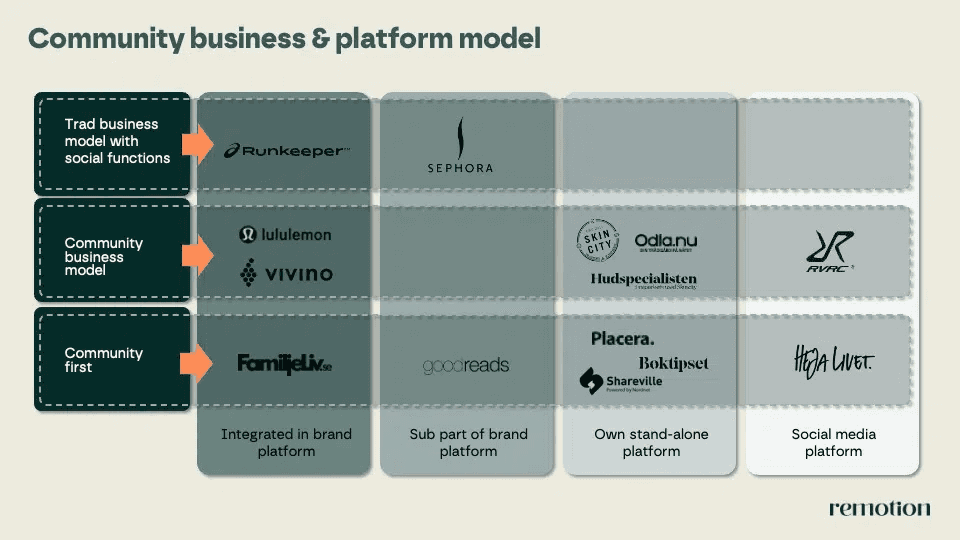
Depending on the business benefits you want to reach, you need to decide how to link the community to your brand and platform. At Remotion, we have built a community business and platform model that shows how different companies design their community strategies. (Figure 1) We have also identified different levels of integration between a brand's community and its business:
Separate brand with no corporate connection
A community can live completely on its own domain and under its own brand. An example of this is boktipset.se, run by Adlibris. The biggest benefit here is gathering honest product reviews and user-generated content.
Own brand connected to your main brand
A common way to connect the brands is using "powered by" or "part of". For example, Nordnet used this for its Shareville forum. This setup makes it easy to link traffic between sites, build loyalty, and strengthen the brand.
Shared brand integrated into your website
Another option is to add the community directly onto your existing website, like Beauty Insider on Sephora's site. This drives organic search traffic directly to you and improves data collection. The risk is that the forum might not feel independent, which can make recruiting new members harder.
Fully integrated into the business model
A community can also be the business model itself. Vivino is a community and marketplace in one; they cannot be separated. For Lululemon, the community is their main marketing engine, and for Revolution Race, it is part of their product development. Companies using this model have often seen rapid, massive growth.
Add social features to your website or app
There is also a lighter model where you simply add basic social features to your app or site, such as ratings, reviews, or the option to follow other users. Asics' running app Runkeeper is a great example of this.
In short, it is important to choose your starting model and plan for the future. You can always merge a separate brand with your own later. If your company is thinking about starting an online community, make sure you understand your target members before choosing a platform, name, and brand. Here are our recommended steps:
Define the purpose, business model, and goals of your community
Determine the value and features the community will offer its members
Create a long-term member recruitment strategy
Identify your technical platform needs
At Remotion, we can help you run a feasibility study, build your business case, and deepen your knowledge of online communities. This is our second article in our series on online communities. You can find the first one here. In our next article, we will cover: