Full Funnel Marketing: Why CRM Needs to Consider the Entire Funnel
|
Post written by
Photo: Windows, Unsplash

You don't start at the end of the sales funnel
Full Funnel Marketing is nothing new for performance and brand teams. But for CRM departments – which often focus way down the funnel on conversion, loyalty, and retention – it's still a method that is rarely used to its full potential.
The result is often short-term campaigns like "10% off for members" or "Book now." These work well for customers who are already in buying mode, but that’s a small group – often less than 5% of your target audience. To build long-term growth, CRM also needs to learn how to work with the entire funnel.
Full Funnel Marketing for CRM can be used in two contexts
Acquiring brand-new customers, starting in channels like advertising and the web to create touchpoints where customers are happy to share their details.
Cross-selling to existing customers, where CRM data is used to build awareness and consideration before introducing a new offer.
The three phases of the sales funnel
To work effectively with Full Funnel Marketing, we need to understand the three main phases of the customer journey. In each phase, customers have different needs, different motivations, and respond to different types of messages.
Awareness: This is where customers are when they don't yet have a clear need, or haven't connected your brand to that need. The goal here is to inspire and get noticed – sparking curiosity and making that first connection.
Consideration: In this phase, the customer understands their need and is actively looking for a solution. The goal is to explain, build trust, and show why your offer makes sense for them.
Conversion: When the customer is ready to act, they need clarity, reassurance, and simplicity. The goal is to help them take that final step to buy, or to buy more if they are already a customer.
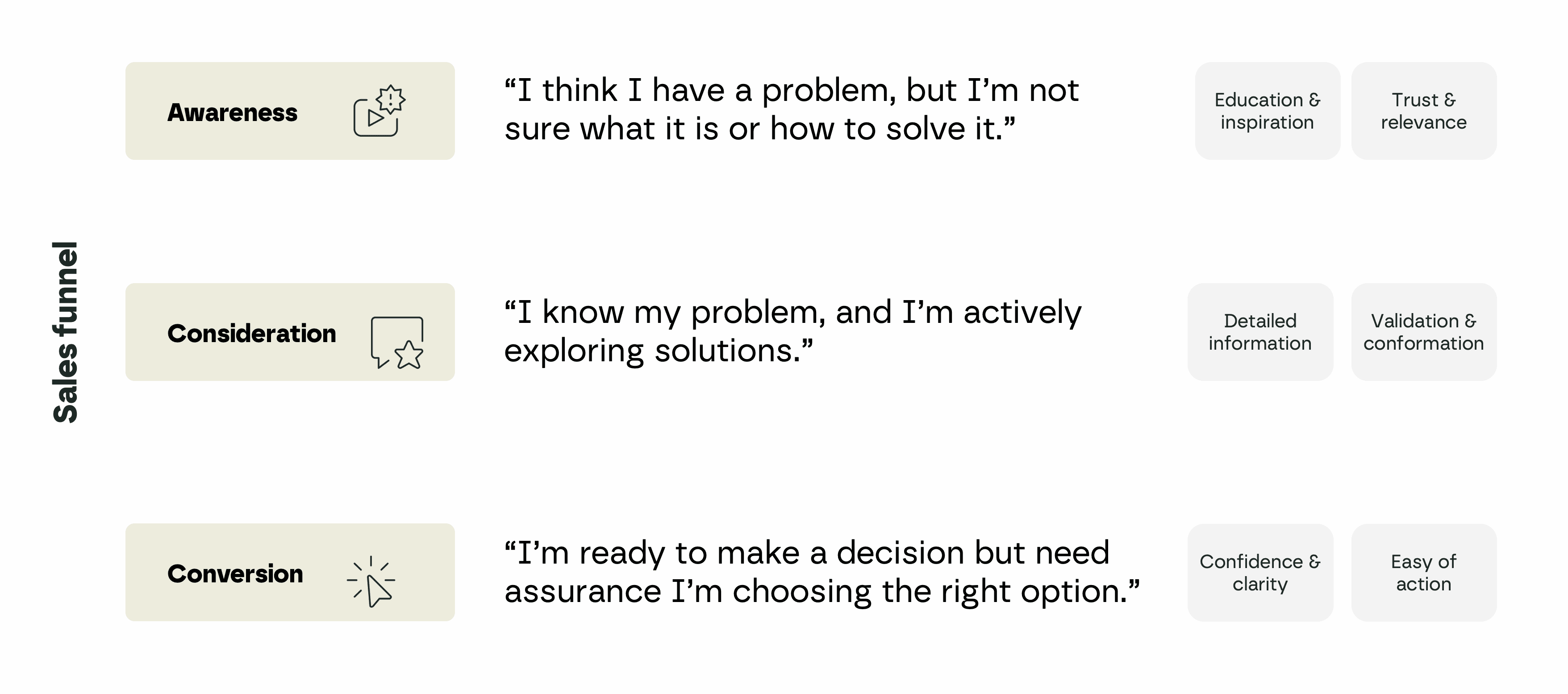
Customers have different needs in each phase of the sales funnel.
Tailoring both content and CTAs (Call to Actions) to these phases is key. If we skip steps or use the wrong communication, we risk losing the customer – either because we are moving too fast or because we aren't helping them through their decision-making process.
How to communicate in each step
A common mistake in CRM is sending the same message across all steps. But customer needs change a lot along the journey – which is why your communication and CTAs (Call-to-Actions) must adapt.
Awareness: Discovery and inspiration
Goal: Help the customer realize they have a need and see that you can help.
Communication: Inspiring, thought-provoking, and often emotional rather than rational. Highlight problems, opportunities, or trends.
Examples: Articles, checklists, inspiration, storytelling, or "did you know" content in emails and push notifications. Reach-focused ads.
KPIs: Reach, impressions, ad recall, open rate, video views, time on page.
Common mistake: Measuring awareness success on conversion.
What types of CTAs are recommended for awareness?
Here, we want to make things as effortless as possible. The customer shouldn't have to make big decisions – just start interacting. The CTAs should be soft, welcoming, and inspiring.
Examples of CTAs
Read more
Discover how…
Get inspired here
Explore our guides
Watch the video
Get tips
Why: These CTAs spark curiosity without asking for commitment. The goal here is engagement and reach, not sales.
DO: Use soft CTAs like "Read more," "Discover how…," or "Get inspired."
DON’T: Ask the customer to buy or sign up right away. Hard CTAs too early create friction.
Consideration: Explaining the value
Goal: Help the customer understand why your offer is the best fit, and build trust.
Communication: More rational and explanatory, but still engaging. Here you need comparisons, guides, and helpful knowledge sharing.
Examples: Guides, self-tests, case studies, product comparisons, personalized landing pages. Chatbots can also help gather info and offer advice.
KPIs: CTR, returning visitors, downloads, form submissions, web engagement.
Common mistake: Skipping consideration entirely and going straight from awareness to conversion.
What types of CTAs are recommended for consideration?
Since the customer is now actively weighing choices, CTAs should invite them to get more info, interact more, and build a closer connection.
Examples of CTAs
Download the guide
See customer stories
Compare options
Try it out" (e.g., calculator, quiz, self-test)
Sign up for our webinar
Talk to an expert
Why: The customer is ready to invest a bit more time and energy. These CTAs should deliver value while gathering more insights and building trust.
DO: Use CTAs that deepen the relationship: "Download the guide," "See customer stories," "Compare options."
DON’T: Keep sending only general inspiration. At this point, the customer wants next steps and actual useful info, not fluff.
Conversion: Keeping it reassuring and simple
Goal: Remove friction and guide the customer to a decision.
Communication: Clear offers, personalization, bold CTAs. Build trust through transparency and social proof, like reviews or case studies.
Examples: Quotes via email, SMS reminders, personalized deals, retargeting flows, and direct outreach.
KPIs: Conversion rate, sales, CPA, lead-to-sale.
Common mistake: Pushing hard sales messages to everyone, even those who aren't ready yet.
What types of CTAs are recommended for conversion?
The customer now has all the info they need. CTAs should be clear, action-oriented, and reassuring.
Examples of CTAs
Buy now
Book today
Get your quote
Start your subscription
Apply now
Unlock discount
Renew here
Why: CTAs should signal speed and ease – no more detours, just action. This is the moment to close the deal.
DO: Use clear, action-oriented CTAs like "Buy now," "Book today," "Get your quote."
DON’T: Bring in too much inspiration or explanation at this stage – it can cause hesitation instead of driving the decision.
Signals and behavioral data—the key to guiding your communication
The secret to full-funnel success is picking up on signals from all channels. Without this, you won't know where a customer is in the funnel – making it impossible to send the right message.
Examples
If we send an awareness email with inspiring content and the customer clicks through, spends time on the page, and engages, that's a clear sign they are ready for consideration. The next message should focus more on guiding and explaining.
A customer who opens several emails but never clicks is likely still in the awareness phase – they need more inspiration, not a sales pitch.
A customer who adds a product to their cart but doesn't buy is already in the conversion phase and should be reached with reminders and incentives.
To make this work, your CRM setup needs to…
Connect data from all channels – email, SMS, web, app, and advertising.
Set up funnel classification – so that customer behavior automatically defines where they are in the funnel.
Automate next steps – ensuring every signal triggers the right type of communication.
This mix of behavioral data and automation is what makes a true full-funnel CRM strategy possible.
How to measure success the right way
Full Funnel Marketing efforts often fail due to using the wrong metrics. A classic error is trying to judge awareness campaigns by conversions. When sales don't happen instantly, people assume the campaign failed – but that's a misstep.
The right approach is to set unique KPIs for each stage:
Funnel Stage | Example KPIs | Focus |
Awareness | Reach, impressions, ad recall, open rate, | Brand visibility & reach |
Consideration | CTR, downloads, form submissions, return visits, web engagement | Interest & evaluation |
Conversion | Conversion rate, sales, CPA, | Business results |
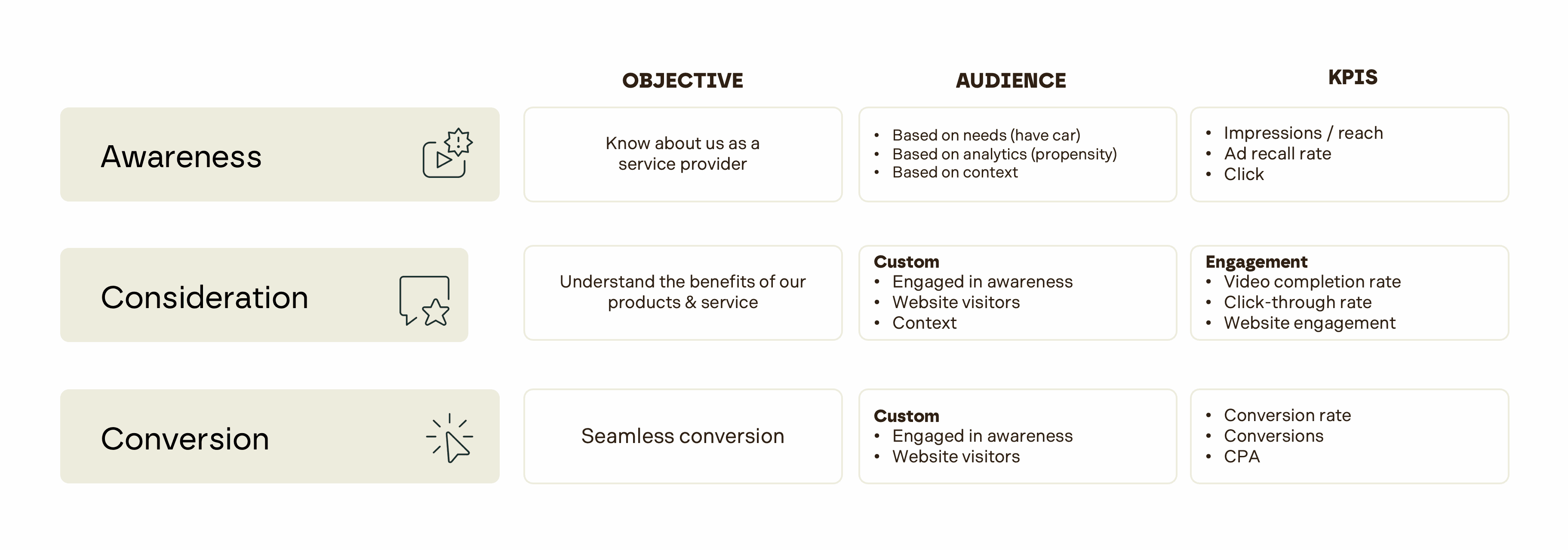
The Customer Journey: Funnel goals, target groups, and KPIs
Measuring this way makes it easy to see where your bottleneck is – and which part of the journey needs a boost.
To sum up
Full Funnel Marketing isn't about turning your CRM team into a performance marketing team. It's about CRM owning the entire customer journey – both when bringing in new customers and cross-selling to existing ones.
This means CRM teams must learn to tailor communication and CTAs to each funnel stage, use behavioral signals to trigger the right next step, set correct KPIs for each phase, and work closely with brand and performance teams to create a seamless experience.
When CRM embraces a full-funnel mindset, email, SMS, and automation templates stop being just quick-fix conversion tools – they become drivers for long-term growth and customer loyalty.