Trigger-based communication: The key to impact with relevance!
|
Post written by
Photo: Museums Victoria
From calendar to trigger-based campaigns
Many CRM teams still rely on calendar-based campaigns. Newsletters, monthly updates, and seasonal promos are planned far in advance and blasted to large groups of customers all at once. The problem is, this approach often misses the mark on relevance. The content quickly feels dated, the impact is short-lived, and once a message is sent, you have to start all over again.
Trigger-based communication is a completely different way of working. Instead of asking "what campaign should we send next month?", we ask "which customer behavior or event should we react to—and what is the best way to do it?". This shift is exactly what makes trigger-based communication one of the most powerful tools for modern customer engagement.
What is a trigger?
Think of a trigger as an event or behavior that, when captured as data, automatically kicks off a message or a workflow. It is simply the answer to when and why we should reach out.
Examples of triggers
A customer buys a car → offer car insurance.
A customer clicks on travel tips → send a travel insurance offer.
A storm warning is issued in a customer's area → send tips on how to prevent damage.
It is important to know the difference between a trigger and a target audience.
Trigger = when/why we communicate.
Audience = who we communicate with.
Why trigger-based communication changes everything
The real magic of trigger-based communication is that it makes your conversation with the customer feel incredibly relevant. You send your message right when the customer is most receptive, which boosts engagement. At the same time, it saves you effort: instead of constantly building new campaigns, you create "always-on" flows that keep running on their own as long as the trigger is active.
Key benefits of triggers
Better relevance – the communication feels personal.
Efficiency – campaigns can be reused and scale easily.
Long-lasting – triggers can keep working for years.
Happier customers – your brand feels helpful and proactive.
Different types of triggers
There are many ways to categorize triggers, but a simple approach is to group them into five main types.
Customer journey triggers: based on an action in the customer's journey, like requesting a quote, logging in for the first time, or filing a claim.
Customer lifecycle triggers: tied to the health of the relationship, such as onboarding, churn risk, or win-back efforts.
Life events: personal milestones like moving, getting married, buying a new car, or having a baby.
External triggers: outside factors like the weather, new regulations, or power outages.
Business-driven triggers: internal needs like launching new products, running seasonal sales, or managing stock.
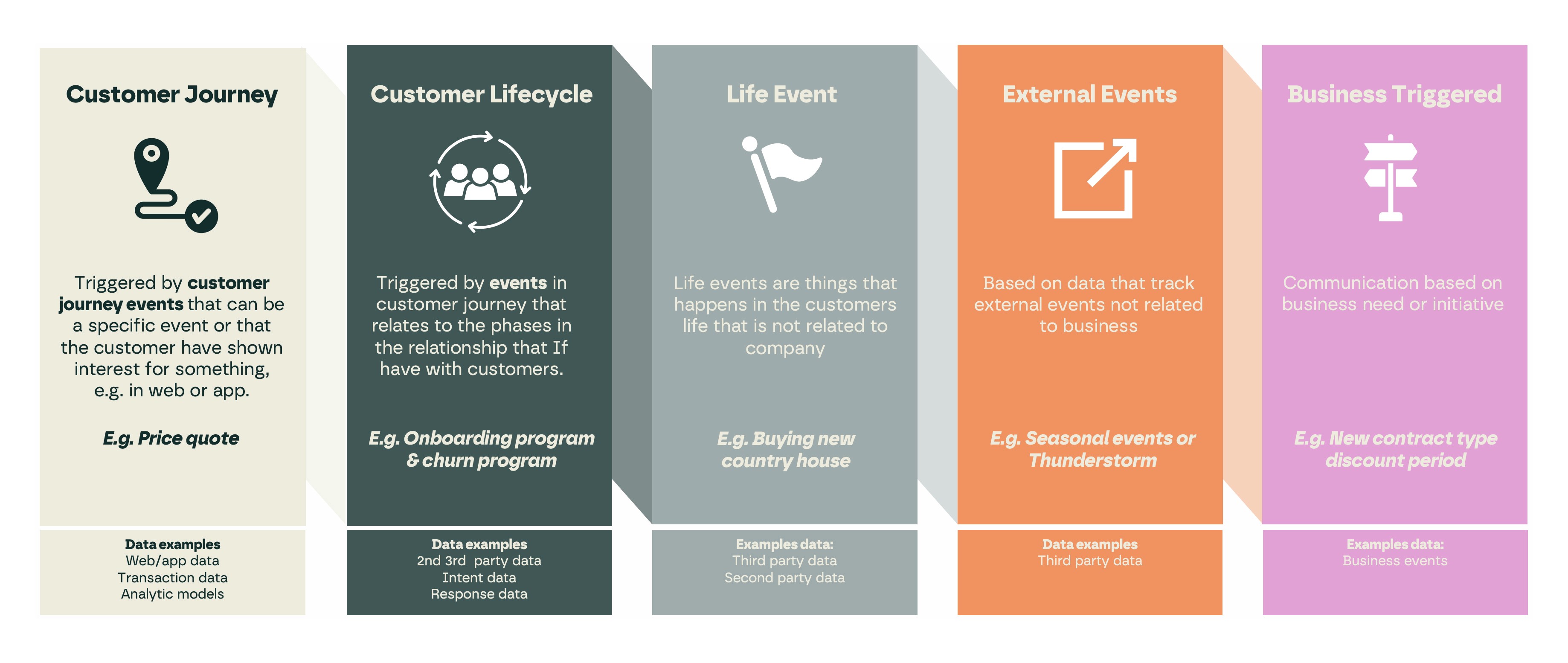
Triggers: There are many different types of triggers for customer dialogue.
Map the customer journey to find the right triggers
A great way to find new, relevant triggers is to do a customer journey mapping. By looking at the customer's experience step-by-step, it becomes easy to see which milestones and needs make perfect starting points for communication.
During this process, you can look at three quick angles for each step of the journey:
Customer needs – what is the customer trying to achieve here?
Customer challenges – what friction or problems might they run into?
Customer actions – what behaviors or signals does the customer show at this stage?
Mapping this out helps you spot exactly where your messages can help. For example, if a customer gets stuck in the research phase (challenge), sending a trigger-based email with a handy guide (need) can be just the push they need to move forward (action).
The result? A clear list of trigger points based on real customer behavior—perfect inspiration for setting up relevant, automated flows.
Think broader about data sources for triggers
For some triggers, especially those based on life events, your own internal data might not be enough. You might not see the signals in time, and to react quickly, you sometimes need to look elsewhere.
This is where second-party data comes in handy. It means partnering with other companies that have the relevant data points you lack—sharing data that is not public, but shared safely and securely.
Examples of second-party data:
Apps: pregnancy trackers, health apps, or pet care apps can give early hints about major life changes.
Retailers: changes in shopping habits can reveal new needs—like when a customer suddenly starts buying pet food, baby items, or home renovation supplies.
Partners in your ecosystem: banks, insurers, realtors, or telecom brands that spot life events before you do.
It is all about thinking bigger: who in the market sees the customer's life changes first, and can we team up to share that signal?
In practice, you will need a solid plan for data sharing, privacy, and consent. Partnerships must be fully transparent and based on customer permission. But when done right, it is a game-changer: instead of reaching out too late, you can be there first with a helpful, timely offer.
This makes second-party data a great match for your own first-party data, opening up brand new trigger possibilities you could not reach alone.
How to build a trigger-based campaign
Building an effective trigger-based campaign is all about taking it step-by-step. First, make sure it makes business sense. How many customers will hit the trigger? How likely are they to buy or sign up? And what is that action worth? This helps you focus on the triggers that bring the most value.
Steps to get started
Define the trigger – what exact event starts the conversation?
Target the audience – who should receive the message?
Design the message – keep the content tightly linked to the trigger event.
Tailor your CTAs – pick call-to-actions that match where they are (inspiration, info, or ready to buy).
Coordinate the channels – decide on the best order for email, push, SMS, or phone calls.
Set up control groups – always test against a group that does not get the message to measure real impact.
Automate and scale – turn the trigger into an "always-on" part of your marketing.
Common mistakes to avoid
A common trap is launching too many triggers at once, which can overwhelm customers and make your messages clash. Another slip-up is making the message too generic—a trigger-based email only works if it feels closely tied to the action that caused it.
What to watch out for
Too many active triggers that overlap and spam the customer.
Messaging that feels too generic or unrelated.
Technical issues – like triggers that are not powered by real-time data.
Confusing the trigger (when/why) with the audience (who).
From batch to event-driven
Traditionally, triggers were run on scheduled batches, like emailing customers whose policy expires in 30 days. This is still useful, but modern event-driven tech lets us go a step further. Now, the event itself—like renewing a contract or buying a product—can instantly fire off a message in real time.
The difference
Batch = runs on a schedule, often hours or days after the event.
Event-driven = happens in real time, the second the event occurs.
The secret ingredient: customer insights
The best trigger strategies run on deep customer insights. With smart analysis, we can spot which customers are thinking of leaving, who is ready to buy more, and who has the highest lifetime value. Predictive models and smart recommendations can make these flows even stronger.
Where to find insights
Analyzing past purchase and usage patterns.
Predictive models that guess future behavior.
Behavioral data from your website, app, and past campaigns.
Wrapping up
Trigger-based communication is easily one of the best ways to boost relevance, efficiency, and customer happiness. By blending real-time data, smart insights, and automation, you can move away from crowded calendar campaigns to an approach that feels personal and timely, every single time.
At the end of the day, it is not just about the tech—it is about understanding your customer's day-to-day life and showing up with the right message, right when they need it.