From Locked to Lifted: How to Develop Your Customer Engagement
|
Post written by
Photo: Marissa Lewis

Three common starting points – and how to take your next step in Customer Engagement
Every business wants to connect with customers through relevant, personalized communication. But the starting line looks different for everyone. Many have been stuck in legacy platforms for years. Others have invested in modern technology, only to find they aren't using it to its full potential. And a growing group of leaders, who are already far ahead, are ready to leap into hyper-personalization and AI.
In this article, we look at these three common scenarios – why companies end up there, and how you can take the next step.
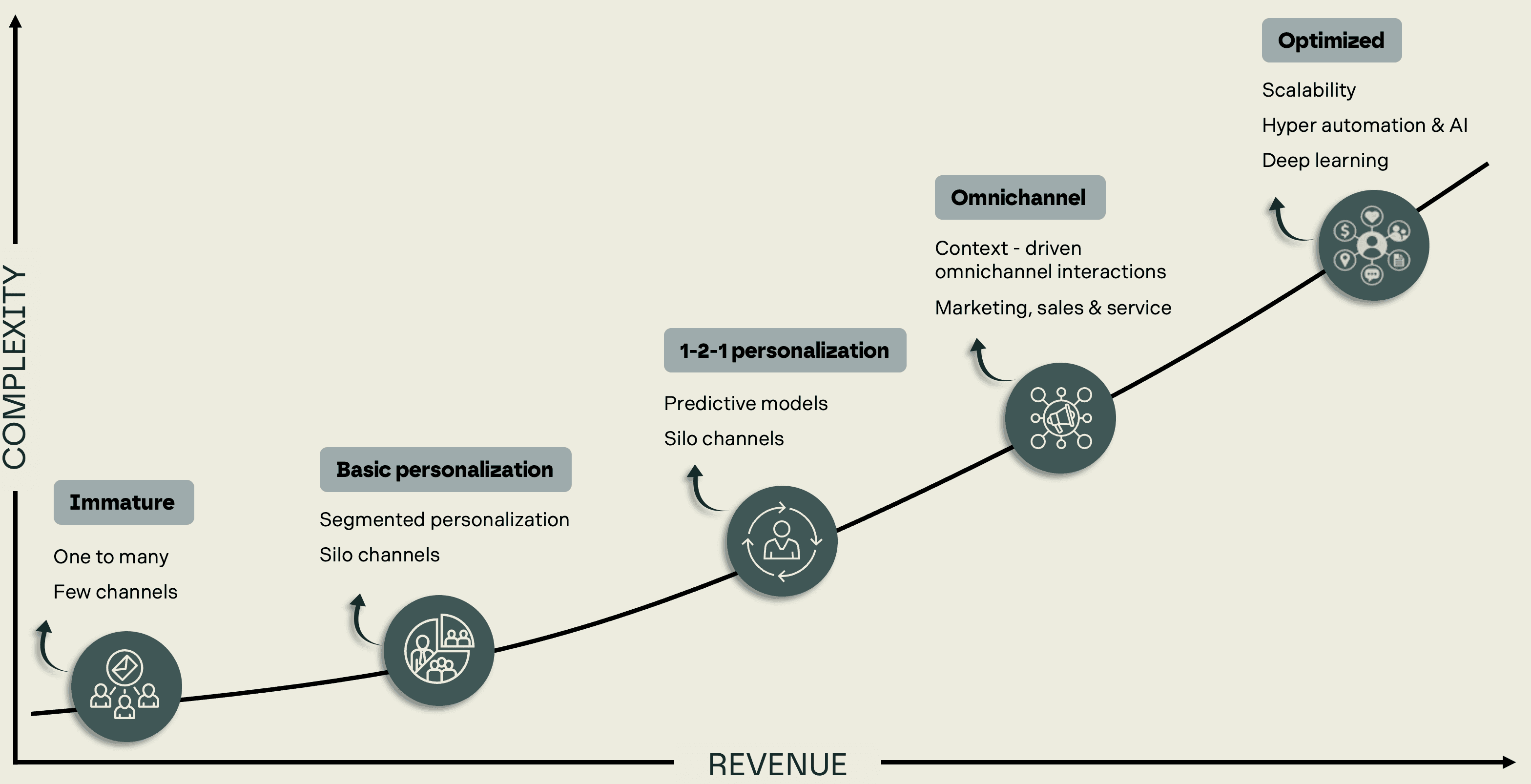
Maturity model. NN transformation in the maturity model.
Situation 1: Legacy tech holding you back
Why does this happen?
For a long time, this was the most common scenario. The tech stack was built 10 to 15 years ago and grew in silos: a CRM over here, an email platform over there, and a loyalty program in its own isolated system. As the demand for real-time, personalized experiences grew, these legacy systems simply couldn't keep up.
Typical hurdles:
Systems don't talk to each other: With every channel running on its own setup, customer data gets scattered. You miss out on a complete picture and can't connect customer behaviors across different touchpoints.
Struggling with real-time data: Older systems usually rely on batch processing. This means insights arrive too late – by the time you're ready to act, the customer has already moved on.
Limited personalization: Legacy platforms often only handle basic segmentation. Your messaging ends up feeling generic and irrelevant to your customers.
Teams get stuck on manual campaigns: Without proper automation, everything has to be done by hand. Every new campaign requires heavy lifting and long lead times, only to deliver short-term results before the team has to start all over again.
The way forward:
Take stock of where you are: Map out your current systems, where your data lives, and what you can actually do today.
Find the bottlenecks: You rarely need to replace everything at once. Usually, swapping out just one or two key parts does the trick.
Build a modern data foundation: A Customer Data Platform (CDP) is often key here to gather your data, unify profiles, and enable real-time action.
Go for quick wins: Start with 2 or 3 simple use cases that show value fast (like welcome journeys, re-engaging inactive customers, or basic email personalization).
Situation 2: Great platforms – but the tech is underused
Why does this happen?
Unfortunately, more and more companies are falling into this trap. They’ve invested in modern tech – like a CDP, marketing automation, and a new CRM – but they aren't seeing the results. Usually, this is because the team doesn't know how to get the most out of it, or the setup wasn't done quite right.
Typical hurdles:
Bumpy setup and architecture: New platforms, especially CDPs, are often poorly integrated. If the underlying IT architecture is outdated, downstream martech can't fix upstream data issues. Without a holistic view, the tools go underutilized.
Siloed teams: Marketing, CRM, e-commerce, and customer service work in their own bubbles. Without shared goals, data flows, and processes, the customer experience ends up feeling fragmented.
Relying on manual campaigns: Teams still spend their days building calendar-based campaigns manually. They take too much time and only deliver short-term spikes.
No clear methodology: The business lacks a blueprint for building relevant, trigger-based campaigns. There is no routine for using insights, personalizing content, or testing and improving over time.
Skill gaps: Even with a spotless technical setup, if the team doesn't know how to run the tools, the system ends up running at a fraction of its true capacity.
The way forward:
Fix the technical foundation: Make sure your platforms are correctly set up and play nice with your overall IT architecture.
Train your team: Build up skills around trigger design, personalization, and data-driven working methods.
Bridge the silos: Get marketing, CRM, e-commerce, and customer service aligned around shared processes and goals.
Pilot trigger-based journeys: Pick a few key customer moments (like churn risk, onboarding, or purchase nudges) and build automated, personalized flows around them.
Situation 3: Already ahead – ready for the next level
Why does this happen?
A growing number of businesses have already done the heavy lifting. They are data-driven, use a modern martech stack, run omnichannel campaigns, and personalize on an individual level. They have the right processes and skills in place. Now, they want to scale up, get even more advanced, and lead the market.
Typical ambitions:
Moving from basic personalization to hyper-personalization across all customer touchpoints.
Scaling up from dozens of use cases to hundreds to drive massive business impact.
Increasing automation so machines manage the day-to-day runs, leaving teams free to focus on strategy.
Building custom AI tools that sit on top of the martech stack to orchestrate, optimize, and make decision-making smarter.
Exploring a composable CDP architecture, choosing and fitting together their own best-of-breed components.
The way forward:
Build a scalable architecture: Ensure your platforms can handle growing data volumes and complex use cases without breaking.
Introduce AI step-by-step: Start with recommendation engines, predictive models, and dynamic content generation before exploring custom AI solutions for competitive advantage.
Adopt systematic testing: Treat every interaction as an experiment to continuously optimize performance.
Secure governance and ethics: As automation and AI scale, make sure you have solid frameworks in place for data quality, privacy, and compliance.
To wrap up
No matter where you're starting from, there’s always a clear path forward.
Stuck with legacy tech? Modernize your setup and build a solid data foundation.
Have modern tech but not using it? Focus on skills, processes, and cross-team collaboration.
Already far ahead? Scale your efforts, dry-run hyper-personalization, and take the next leap with AI and tailored architecture.
The most important thing is to identify where you stand today – and start taking steps toward tomorrow.